

- General Information About Rating
- Corporate Credit Rating Methodology
- Bank and Financial Institutions Credit Rating Methodologies
- Corporate Governance Rating Methodology
- Sustainability Methodologies
- Rating Methodologies Related to Securitisation
- The Methodology of Country Rating
- Project Finance Rating Methodology
- Rating Methodology of Local Authorities and Their Issuances
- Multilateral Development Banks, Financial Institutions, Other Supranational Institutions Rating Methodology
- Sovereign Rating Methodology
- Public Enterprises Rating Methodology
- JCR-ER Rating Update Policies
- Case of Default and Probability of Default Definitions
- Notations
- Statistics
SYNTHETIC SECURITISATION RATING METHODOLOGY
1. GENERAL OVERVIEW OF SYNTHETIC SECURITISATION
Securitization is the process of pooling receivables or asset groups on the balance sheet that are expected to generate identifiable and predictable future cash flows, and issuing securities backed by that pool for sale to investors. Within this general framework, synthetic securitization refers to the transfer of the credit risk associated with such a pool to third parties through credit derivatives or financial guarantees, rather than removing the asset pool from the balance sheet.
Under this structure the underlying assets remain on the originator's balance sheet; only the credit risk arising from those assets is transferred under a credit protection agreement concluded between the protection buyer and the protection seller. This allows the originator to preserve the customer relationship and ownership of the assets while, provided the relevant regulatory conditions and significant risk transfer criteria are met, reducing risk-weighted assets and improving its capital adequacy ratio.
Securitization transactions may be assessed analytically under two main groups according to the manner in which credit risk is passed on to investors:
✓ Traditional (Cash) Securitization: Transactions in which the underlying assets are transferred to a special purpose vehicle through a true sale, legal isolation is achieved through the transfer of ownership, and payments to investors are funded by collections from the pool.
✓ Synthetic Securitization: Transactions in which no true sale takes place, the reference portfolio remains on the originator's books and only credit risk is transferred contractually. The principal risk borne by the investor or protection seller is linked to the credit performance of the reference portfolio rather than to the general credit risk of the originator.
This distinction directly determines the scope of the rating analysis. In synthetic securitization transactions, the rating is based not only on the credit risk of the underlying portfolio, but also on the payment capacity of the protection seller, the quality of the collateral and the legal robustness of the transaction documents. This multi-layered structure requires the legal, operational and counterparty risk dimensions of the credit protection to be assessed alongside the credit risk of the reference portfolio.
Figure 1: Traditional Securitization and Synthetic Securitization .png)
2. SEGMENTATION
Synthetic securitization transactions differ materially from one another depending on the type of protection mechanism, the underlying asset class and the tranche structure. JCR ER therefore assesses such transactions by segmenting them on the basis of protection structure and underlying asset. Traditional securitization transactions based on a true sale fall outside the scope of this methodology and are addressed under a separate methodological framework.
Depending on the manner in which credit protection is provided, transactions are assessed under three main structural categories:
1. Funded Synthetic Securitization (F): Structures in which the protection seller posts cash collateral by purchasing credit-linked notes (CLN). The collateral is held in a segregated escrow account and, upon the occurrence of a credit event, the protection payment is met from that account.
2. Unfunded Synthetic Securitization (U): Structures in which the protection seller provides an undertaking through a credit default swap (CDS) or a financial guarantee without posting cash collateral. The protection payment becomes due only upon the occurrence of a credit event.
3. Hybrid Synthetic Securitization (H): Structures in which funded and unfunded components coexist within the same transaction. Typically, the mezzanine tranche is funded through CLNs while the senior tranche is protected by an unfunded guarantee or CDS.
The main segments are further divided into sub-segments across eight underlying asset classes, so that the underlying assets can be assessed against criteria appropriate to their product characteristics and risk profile: Generic, Corporate Loans, SME Loans, Commercial Real Estate Loans (CMBS), Residential Mortgage Loans (RMBS), Consumer Loans, Credit Card Receivables and Auto Loans.
The combination of protection structure and underlying asset class gives rise to a total of 24 assessment models. Weight assignment and methodological calibration are carried out through three models segmented by protection structure together with eight underlying asset class models; the final model for a given transaction is derived from the intersection of these two dimensions.
3. STRUCTURE OF SYNTHETIC SECURITISATION TRANSACTIONS
3.1 Protection Structures
In a funded structure, the cash is transferred to the special purpose vehicle or account bank at the moment the protection seller pays for the CLN; these funds are generally invested in short-term, high-quality instruments. From the protection buyer's perspective this structure stands out as the model that minimizes counterparty risk, since payment capacity depends not on the future financial condition of the protection seller but on cash paid in and segregated at inception.
In an unfunded structure, the protection seller is typically a multilateral development bank, an international financial institution or a highly rated bank, as confidence that the protection seller can meet its payment obligation without any collateral support rests largely on that institution's credit rating. The principal advantages of this structure are lower transaction cost and operational simplicity.
Hybrid structures generally arise from a practical constraint: a single protection seller may not be willing or able to fund the entire transaction, or the protection buyer may wish to optimize total transaction cost. Funding the mezzanine tranche provides strong assurance for the layer with the highest risk density, while leaving the senior tranche unfunded reduces the overall cost of the transaction.
3.2 Pooling, Tranching and Risk De-linking
The synthetic securitization mechanism operates through the combination of three core elements. Pooling is the selection of reference obligations subject to credit risk transfer in accordance with predefined eligibility criteria in order to form a reference portfolio; no physical transfer of assets takes place in this process. Tranching is the layering of the credit risk of the reference portfolio from the junior to the senior tranche. Risk de-linking is achieved not through a transfer of ownership but through the contractual separation of the credit risk arising from the reference portfolio from the general credit risk of the originator.
In synthetic securitization, tranching is not always achieved through the issuance of securities carrying different credit ratings as in traditional securitization, but rather by dividing the scope of the credit protection agreement into loss bands. Credit protection may accordingly be defined between a given attachment point and detachment point.
Loss allocation follows the waterfall principle; however, unlike the cash flow redemption order in traditional securitization, this structure represents the order of loss allocation. This sequential erosion mechanism ensures that protection sellers are exposed only to losses falling within the loss band they have assumed.
Figure 2: Tranching and Loss Bands .png)
3.3 Risk Mitigation Features
The risk mitigation capacity of the transaction structure is analyzed by assessing, in combination, the tranching structure, the scope of the credit protection agreement, the credit quality of the protection seller, the collateralization mechanism, the use of synthetic excess spread and amortization triggers.
✓ Synthetic Excess Spread: An amount contractually designated by the originator on a periodic basis, calibrated by reference to the difference between the yield on the reference portfolio and the protection premium plus transaction costs, which absorbs losses before they are allocated to the tranches. A “trapped” structure increases the continuity of protection, whereas a “use-it-or-lose-it” structure provides a more limited protective effect.
✓ Counter-Guarantee: A secondary risk mitigation feature provided by central governments, central banks, development banks or multilateral institutions that enhances the reliability of the protection chain.
✓ Collateral and Account Bank Safeguards: Holding collateral in a segregated account, minimum rating conditions for the account bank, replacement mechanisms, and haircut and top-up provisions.
✓ Pro-Rata/Sequential Amortization Switch Triggers: Mechanisms that, upon deterioration in portfolio performance, reorder the priority of principal distributions in favor of senior tranches and thereby help preserve the level of credit enhancement.
4. SYNTHETIC SECURITISATION RATING METHODOLOGY
In the field of synthetic securitization, the assessment underlying the Synthetic Securitization Rating (SSR) is not limited to the probability of default of the protection buyer. This reflects the greater complexity of synthetic securitization and the fact that it brings together different components: the reference portfolio, the protection mechanism and the protection seller.
Although the criteria and areas of analysis considered by the methodology vary according to the protection structure and the underlying asset class, all three protection structures are assessed within the same methodological framework. In this respect the SSR methodology differs from the traditional structured finance methodology, which provides for separate frameworks by issuance type; it is applied through a single framework with weights and thresholds calibrated at model level.
Figure 3: Analytical Framework 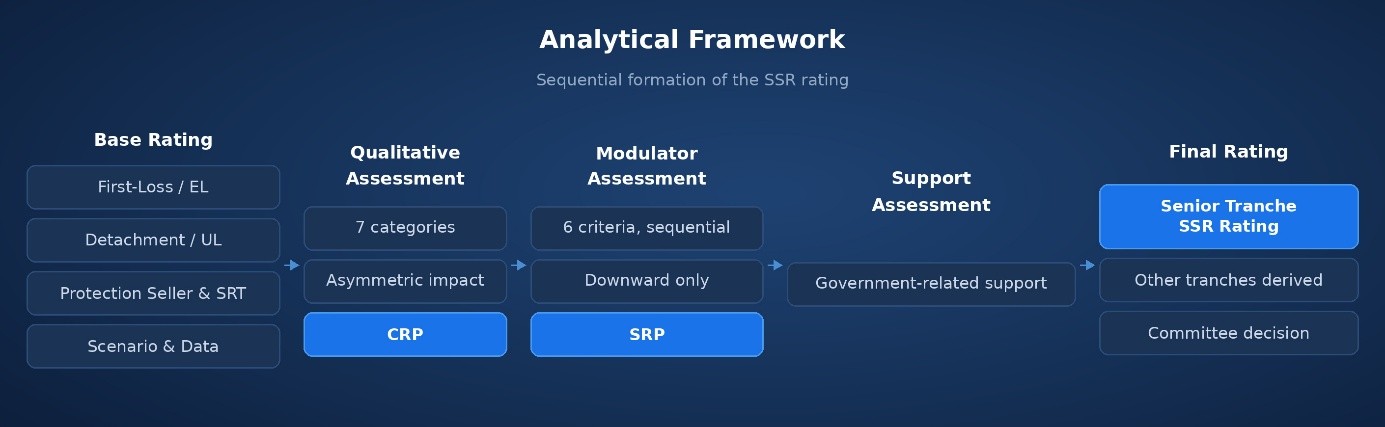
4.1 Base Rating
The Base Rating constitutes the starting point of the SSR formation process and is produced by combining, through matrices and transition matrices, a set of criteria relating to the structural calibration of the transaction and the core reliability of the protection mechanism.
At the core of the Base Rating are the ratio of the thickness of the first-loss tranche to expected loss (EL) and the ratio of the point at which the senior tranche attaches (the detachment point) to unexpected loss (UL) calculated under the adverse scenario. Where the first-loss tranche is only equal to, or falls below, expected loss, the protection seller is required to absorb even ordinary and foreseeable losses; this weakens the economic rationale of the transaction, since the purpose of synthetic protection is to provide cover against exceptional losses.
Following the structural calibration, the Base Rating is adjusted through a matrix reflecting the credit quality of the protection seller and whether the conditions for recognition of significant risk transfer (SRT) are met; finally, the reliability of the analytical basis of the transaction — the clarity of scenario separation and the sufficiency of data — is tested.
4.2 Qualitative Assessments
Qualitative assessments are conducted through a common category structure across all models, although weighting levels differ according to the protection structure and the underlying asset class. The outcome of the qualitative assessment adjusts the Base Rating within a defined band, producing the Core Risk Profile (CRP).
The impact range of the qualitative assessment on the Base Rating is asymmetric. Where the large majority of criteria are met, this confirms that the transaction meets the expected minimum standard and supports the Base Rating by a measured margin. By contrast, where weaknesses are identified across a significant portion of the criteria, this indicates not merely an isolated shortcoming but, in most cases, an interrelated and cumulative risk pattern — a stronger signal that the structural calibration underlying the Base Rating may not operate in practice as anticipated.
4.3 Modulator Assessments
Unlike the qualitative criteria, modulators are not subject to weighted scoring; the option selected for each modulator criterion produces, on its own and directly, a rating adjustment or a rating cap. Reflecting the outcome of the modulator assessment produces the Standalone Risk Profile (SRP).
The principal purpose of the modulator stage is to ensure that circumstances with a high impact on the credibility of the transaction but a low frequency of occurrence are properly addressed. Six modulator criteria are applied in a defined order and on a cascading basis, with the effect of each criterion calculated on the rating resulting from the modulators applied before it: extraordinary risk factor, early termination, related party relationship, first-to-default basket structure, originator creditworthiness and collateral reinvestment risk level.
A common design principle applies to most modulators: the effect of the most adverse option varies according to the rating band reached by the transaction up to that point. This reflects the principle that the same weakness identified in a higher-rated transaction carries a relatively more serious warning.
4.4 Stress Testing, Scenario and Macroeconomic Assessments
In synthetic securitization transactions, the stress testing assessment is based not on JCR ER re-testing the transaction on a standalone basis, but on reviewing the reasonableness of the stress tests carried out by the protection buyer in respect of the reference portfolio and the protection structure. The scenario design, shock magnitudes, risk factor selection and realism of the assumptions used by the protection buyer are compared against the reference stress tests produced internally by JCR ER for the relevant asset class and macroeconomic outlook.
Unlike the qualitative criteria, macroeconomic and sectoral assessments do not produce a score that directly affects the SSR rating. Their function is to establish an independent reference point against which the macroeconomic assumptions used by the protection buyer in its stress tests and scenario analyses can be compared. Where a material divergence exists between the two sets of tests, the effects are reflected in the rating through the Base Rating mechanism and the qualitative assessment criteria.
4.5 Approach to Significant Risk Transfer (SRT)
In rating synthetic securitization transactions, JCR ER does not treat regulatory recognition of significant risk transfer as a determinative rating input on its own. While regulatory SRT recognition is important for the originator's ability to benefit from credit risk mitigation in its capital calculation, the assessment for rating purposes is based on whether the credit protection mechanism is workable in economic, legal and operational terms.
Accordingly, satisfying the quantitative threshold is not in itself regarded as sufficient. The provision of implicit support, the cost of protection becoming disproportionate to the capital relief obtained, a synthetic excess spread undertaking effectively narrowing the risk transferred, early termination and call options being capable of removing protection at the very point it is most needed, and credit event definitions and loss allocation mechanisms being structured so as to impede the actual transfer of risk, are all treated as circumstances that undermine the substance of risk transfer even where the quantitative threshold is met.
Where the economic and legal nature of the risk transfer cannot be reliably established, or where the core protection mechanism is not capable of being analyzed, JCR ER may refrain from assigning a rating to the transaction.
4.6 Support Assessments
Unlike the traditional structured finance methodology, the synthetic securitization methodology does not apply a group support assessment. The group support criterion rests on the assumption that the fund has an independent cash flow derived from collections on the reference portfolio, an assumption specific to the traditional true-sale structure. In synthetic securitization there is no such fund in unfunded structures; and even in funded structures the cash flow of the special purpose vehicle derives not from collections on the reference portfolio but from the collateral posted.
The support assessment therefore focuses solely on government-related support elements. While applicable across all models irrespective of the protection structure, it is limited, in terms of underlying asset class, to the corporate loan and commercial real estate models. Four criteria are assessed — the level of government managerial control and ownership, state revenue guarantees, activities of public relevance, and support provided through legislation — and the highest of the resulting outcomes is taken as the basis.
4.7 Rating Differentiation Between Tranches
The methodology is constructed principally around the rating of the senior tranche (the Senior Tranche SSR Rating). Where, in a three-tranche structure, the mezzanine tranche requires a rating of its own, that rating is not recalculated independently of the senior tranche rating; it is instead derived from the senior tranche rating by applying a notch differential determined by reference to the risk profile of the junior tranche.
The notch differential is determined by combining, through a transition matrix, the analysis of the ratio of first-loss thickness to expected loss and the ratio of the detachment point to unexpected loss. The first-loss/equity tranche, in both two- and three-tranche structures, is typically retained by the originator and subject to the risk retention requirement; accordingly, no SSR rating is assigned to that tranche and it is classified as Not Rated (NR).
4.8 Preliminary and Final Ratings
The principal rating opinion is the final SSR rating assigned once the final transaction documents, reference portfolio data, credit protection agreement, collateral structure, protection seller information, legal opinions and closing conditions have been analyzed. Where requested prior to closing, a preliminary or indicative assessment may be prepared on the basis of draft transaction documents, provisional reference portfolio data and assumed structuring parameters.
A preliminary rating does not constitute a final rating and does not represent an undertaking that the final SSR rating assigned after closing will be at the same level. It is treated solely as a conditional credit opinion formed on the basis of the information and assumptions available at the assessment date; it may be revised, may differ from the final rating, or may be withdrawn.
5. RATING COMMITTEE
The final stage of the JCR ER synthetic securitization methodology is the assessment of the rating committee. The committee determines the final rating for the issuance after reviewing all analyses performed and the risks identified.
The committee provides an assessment process conducted independently of the analysts, adding a further layer of control to the rating process by re-examining the analysts' reports and recommendations. Taking the methodological outputs as its basis, the rating committee assigns the final rating by majority vote, also taking into account the expert judgement of the analysts, issuance-specific information, exceptional circumstances and peer group comparisons.
6. SURVEILLANCE PROCESS
The validity of SSR ratings is determined in line with the maturity of the protection agreement, and the ratings assigned cease to be valid upon expiry of the protection period. Given the dynamic nature of synthetic securitization transactions and their exposure to matters such as the performance of the reference portfolio, the credit quality of the protection seller, the market value of the collateral and the structural integrity of the transaction, SSR ratings are reviewed regularly and revised where necessary until the protection period expires.
Surveillance covers the creditworthiness of the originator, the status and credit quality of the protection seller, the continued validity of the conditions for recognition of significant risk transfer, the independence of transaction parties, the scenario assumptions determined prior to issuance together with expected loss (EL) and unexpected loss (UL) ratios, and the current market value and liquidity of funded collateral. In transactions incorporating a replenishment period, the compliance of added assets with the eligibility criteria is also assessed together with the evolution of the overall risk profile of the portfolio.